
Educational Type & Method
Educational Type

The first step is to identify how the continuing education was completed by selecting the appropriate Educational Type.
Choose either Live or Self-Study
-
Choose Live if the CE activity was attended in real time, such as an in-person course, live webinar, conference, lecture, or workshop.
-
Choose Self-Study / On-Demand if the CE activity was completed independently at your own pace.
Note: If you're entering a Non-Course Related CE Activity, we recommend selecting Live as the Educational Type. Most non-course CE activities involve participation in or completion of a professional activity rather than self-paced educational content.
Educational Method
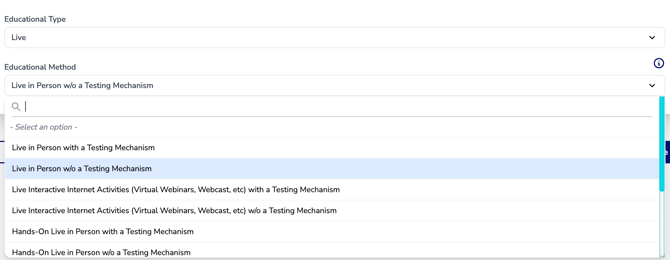
Choose the method that best describes how the continuing education activity was delivered.
The available educational methods are listed below, along with a description of each option to help you select the one that best matches your CE activity.
Live:
Live-in person-held at a physical location, where the attendee is physically present ‘in-person’ at the event.
Live interactive internet activities (virtual webinars, webcasts, etc.) with a testing mechanism-Synchronous learning, held in real-time via the internet with the ability to interact with the instructor/audience. A passing grade from some sort of post-test mechanism is required to receive credit.
Live interactive internet activities (virtual webinars, webcasts, etc.) without a testing mechanism-Synchronous learning, held in real-time via the internet with the ability to interact with the instructor/audience. A post-test mechanism to receive credit is NOT required.
Hands-on Live in person-held at a physical location, where the attendee is physically present ‘in-person’ at the event and requires the participant to physically engage in a skill or activity to practice a skill or technique under the supervision of an instructor.
Hands-on Live interactive internet activities (virtual webinars, webcasts, etc.) with a testing mechanism. Synchronous learning, held in real-time via the internet with the ability to interact with the instructor/audience. Participants physically engage in a skill or activity to practice a skill or technique under the supervision of an instructor via the Internet. A passing grade from some sort of post-test mechanism is required to receive credit.
Hands-on Live interactive internet activities (virtual webinars, webcasts, etc.) without a testing mechanismSynchronous learning, held in real-time via the internet with the ability to interact with the instructor/audience. Participants physically engage in a skill or activity to practice a skill or technique under the supervision of an instructor via the Internet. A post-test mechanism to receive credit is NOT required.
Hands-on protocol courses- Long-term courses that involve formal educational sessions “on-site” & in office practice of techniques learned without supervision
Blended Learning activities with a testing mechanism- Activities that include both live sessions with self-study materials. A passing grade from some sort of post-test mechanism is required to receive credit.
Blended Learning activities without a testing mechanism Activities that include both live sessions with self-study materials. A post-test mechanism to receive credit is NOT required.
Self-Study / On-Demand:
Pre-recorded live interactive virtual webinar with a testing mechanism - Asynchronous learning, these are CE programs that are recorded from a CE program that was held in real-time. Attendees learn on their own schedule. A passing grade from some sort of post-test mechanism is required to receive credit.
Pre-recorded live interactive virtual webinar without a testing mechanism - Asynchronous learning, these are CE programs that are recorded from a CE program that was held in real-time. Attendees of this educational method are not present at the time of delivery and have the flexibility to learn on their own schedule. A post-test mechanism to receive credit is NOT required to receive credit.
Pre-recorded audio/visual programs (asynchronous) with a testing mechanism - Asynchronous learning. Pre-recorded/Audio Visual programs are defined as: YouTube, podcasts, DVDs, Videocassettes, CD-ROM, pre-recorded webinars, etc. Attendees of this educational method are not present at the time of delivery and have the flexibility to learn on their own schedule. A passing grade from some sort of post-test mechanism is required to receive credit.
Pre-recorded audio/visual programs (asynchronous) without a testing mechanism - Asynchronous learning. Pre-recorded/Audio Visual programs are defined as: YouTube, podcasts, DVDs, Videocassettes, CD-ROM, pre-recorded webinars, etc. Attendees of this educational method are not present at the time of delivery and have the flexibility to learn on their own schedule. A post-test mechanism to receive credit is NOT required to receive credit.
Article-based CE programs with a testing mechanism- Asynchronous learning where the subject matter is delivered in a written format with identified learning objectives and structured content specifically designed for the CE program. A passing grade from some sort of post-test mechanism is required to receive credit.
Article-based CE programs without a testing mechanism- Asynchronous learning where the subject matter is delivered in a written format with identified learning objectives and structured content specifically designed for the CE program. A post-test mechanism to receive credit is NOT required to receive credit.
Free-Learning accompanied by a written summary of what was learned- Asynchronous learning is defined as: materials not designed as a structured educational program but read for the purpose of broadening one's understanding or comprehension of a subject matter. Ex: textbooks, journal articles, periodicals, etc. A written summary stating what was learned is required.
Free-Learning NOT accompanied by a written summary of what was learned- Asynchronous learning is defined as: materials not designed as a structured educational program but read for the purpose of broadening one's understanding or comprehension of a subject matter. Ex: textbooks, journal articles, periodicals, etc. A written summary stating what was learned is NOT required